China’s anchor industry serves commercial shipping, offshore energy, fishing fleets, and specialized marine projects. Its manufacturers range from large state-backed groups to focused private factories. Their products may include stockless anchors, high holding power anchors, mooring anchors, and custom offshore designs.
Marine author Nigel Calder offers a practical warning: “An anchor is only as good as the bottom it is set in.” This point matters when comparing Chinese manufacturers. A well-machined anchor cannot compensate for poor seabed knowledge, incorrect sizing, or weak deployment procedures. Buyers should examine more than catalog photographs.
This guide will assess the top anchor manufacturers in China through product capability, material quality, testing systems, and export experience. It will also consider factory transparency. Can the supplier provide traceable steel certificates? Are welds inspected? Are load tests documented? These details often reveal more than polished marketing language.
Some manufacturers specialize in large marine anchors. Others focus on smaller vessels or customized designs. Their strengths are not identical. Price can be attractive, but low cost may hide thinner coatings, inconsistent tolerances, or limited after-sales support.
That risk deserves attention.
The ranking will not pretend to be perfect. Public information changes, factory capabilities evolve, and customer requirements differ. A manufacturer trusted for a 20-ton ship anchor may not suit a compact workboat. Readers should verify current certifications, production capacity, and testing records before making a final decision. This approach supports a more reliable understanding of China’s Anchors manufacturing landscape.
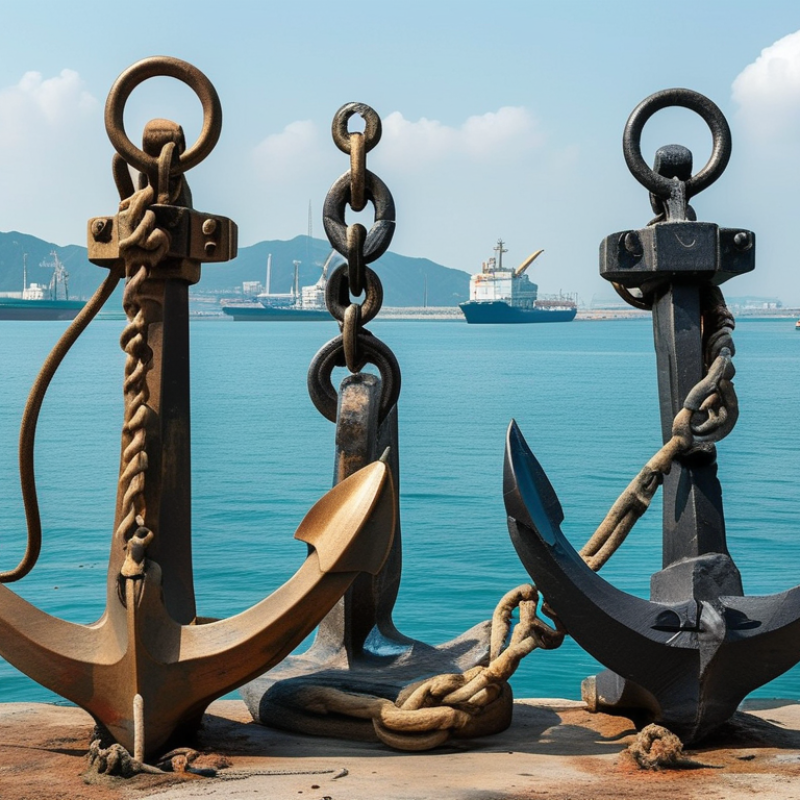
A top anchor manufacturer is defined by verified performance, not catalogue size. UNCTAD’s Review of Maritime Transport 2024 reports that global maritime trade reached about 12.3 billion tonnes in 2023. That scale increases demand for dependable anchoring equipment. Experienced manufacturers control steel chemistry, casting quality, heat treatment, machining, and weld inspection. They should provide material certificates, production records, and load-test results for each batch.
ISO 1704 specifies requirements for ship anchors and related dimensions. Reliable factories also understand classification-society procedures and SOLAS-related equipment expectations. Their testing should include proof-load verification, dimensional checks, shackle compatibility, and surface inspection.
Practical details reveal competence: clean fluke edges, uniform pin fit, protected storage, and clear markings on every anchor. A serious supplier can explain how its design performs in mud, sand, or rough seabeds.
Top manufacturers maintain traceability from steel receipt to final inspection. They use calibrated test equipment and documented corrective actions. This reflects the quality principles described in ISO 9001, although certification itself cannot replace technical judgment. Buyers should inspect factory records, not only certificates. A polished catalogue can still mislead.
Supply reliability also includes packaging, export documentation, spare-part support, and honest lead-time estimates. Some manufacturers communicate well before payment, then become vague after shipment. That warning deserves attention. The strongest suppliers welcome independent inspection and discuss failure risks openly. No factory is perfect, and even a proven design may need adjustment for vessel size, operating depth, and seabed conditions.
China’s anchor manufacturing industry is structured around specialized production networks, not only large factories. Steel mills supply plate, bar, and high-strength alloy materials. Forging workshops then shape shanks, flukes, and crowns under controlled temperatures. Some producers use casting for complex forms. Others prefer forged parts for demanding marine applications.
Production often moves through several independent stages. A machining supplier may drill pin holes, while another facility handles galvanizing, painting, or protective coatings. Final manufacturers assemble components, check dimensions, and prepare export documents. This structure supports flexible order volumes. It also creates quality differences between suppliers.
Experienced buyers inspect more than factory size. They review material certificates, heat numbers, load-test records, and inspection procedures. A reliable manufacturer should explain anchor weight, holding-force testing, surface treatment, and packaging methods clearly. Photos are useful, but physical samples reveal more. A sample may show uneven coating or rough edges.
Many factories serve commercial vessels, fishing operations, ports, and construction projects. Their technical teams usually adapt designs to seabed conditions, vessel size, and chain specifications. Some factories have in-house testing equipment. Others use independent laboratories. That difference matters. Documentation can look complete while traceability remains weak.
China’s manufacturing structure is efficient, but not flawless. Subcontracting may reduce costs, yet it can blur responsibility. Factory audits, production samples, and pre-shipment inspections help control that risk. I would not judge capability from a polished showroom alone. Shop-floor discipline tells more. Ask who made each critical component.
China’s marine anchor manufacturing industry is closely linked to the country’s shipbuilding ecosystem. The chart uses China’s share of global shipbuilding completions, new orders, and order backlog as a demand and industrial-capacity proxy for anchor suppliers.
Source: China Association of the National Shipbuilding Industry and related 2023–2024 industry statistics. Figures represent China’s percentage share of global commercial shipbuilding indicators, not individual manufacturer market share.
Chinese anchor manufacturers serve a maritime market carrying over 80% of global merchandise trade by volume, according to UNCTAD’s Review of Maritime Transport 2024. Their product ranges commonly include stockless, Hall-pattern, high-holding-power, and offshore anchors. Buyers may also find stud-link chains, shackles, swivels, and deck handling equipment from the same production network.
Manufacturers usually support anchors for bulk carriers, tankers, tugboats, fishing vessels, and offshore platforms. A typical order may require forged or cast steel, protective coating, certification, and load testing. Product dimensions can range from compact harbor anchors to multi-ton assemblies for large commercial vessels. Compatibility matters. ISO 1704:2021 provides requirements for stud-link anchor chains, while classification approval confirms manufacturing and testing controls.
From practical procurement experience, the catalog is only the starting point. Factory audits should check heat-treatment records, welding procedures, calibration logs, and proof-test results. Some suppliers present wide product ranges but outsource important processes. That deserves careful questioning. Lead times also vary with mold preparation, machining, coating, and inspection schedules. Chinese manufacturers can offer strong customization, yet drawings must state holding force, shank geometry, material grade, tolerances, and certification needs. Small omissions become expensive at the quay.
The table below summarizes major product categories and commonly available manufacturing capabilities in China without listing individual company or brand names. Actual dimensions, approvals, and delivery terms depend on vessel requirements, technical drawings, classification rules, and inspection arrangements.
| Product Category | Typical Product Range | Common Materials | Typical Vessel or Marine Use | Manufacturing and Customization Features | Quality and Approval Options |
|---|---|---|---|---|---|
| Stockless Anchors | Approximately 50–20,000 kg Cast or fabricated designs | Cast carbon steel, cast alloy steel, and forged or rolled steel components where required | Cargo vessels, bulk carriers, tankers, passenger ships, workboats, and general commercial vessels | Flukes, crowns, shanks, and pins can be produced according to approved drawings; options may include galvanized, painted, or machined surfaces | Dimensional inspection, chemical and mechanical testing, non-destructive testing, and classification inspection when specified |
| High-Holding-Power Anchors | Approximately 100–25,000 kg High-holding-power profiles | High-strength cast steel, carbon steel, and alloy steel for selected load-bearing components | Large commercial ships, offshore support vessels, dredgers, heavy-duty workboats, and vessels operating in demanding seabed conditions | Profile optimization, reinforced flukes, controlled casting, precision machining, and production based on vessel-specific holding-force requirements | Holding-force testing, load testing, material traceability, dimensional reports, and approval by a recognized classification society when required |
| Admiralty Pattern Anchors | Approximately 20–10,000 kg Traditional fluke-and-stock design | Forged steel, cast steel, carbon steel, and galvanized steel components | Traditional vessels, museum or heritage ships, small commercial craft, pontoons, and specialized marine equipment | Custom stock dimensions, shank lengths, ring sizes, fluke geometry, and surface finishes can be manufactured from drawings or samples | Visual inspection, dimensional verification, weld inspection where applicable, and material certificates |
| High-Holding-Power Folding Anchors | Approximately 10–500 kg Compact handling design | Galvanized carbon steel, stainless steel for selected fittings, and corrosion-resistant steel components | Fishing boats, yachts, rescue craft, small workboats, pontoons, and recreational vessels | Folding or hinged components, compact storage dimensions, customized shanks, and different connection fittings | Load testing, corrosion-resistance checks, dimensional inspection, and small-craft technical documentation |
| Danforth-Style Anchors | Approximately 2–250 kg Wide-fluke lightweight format | Pressed or fabricated carbon steel, galvanized steel, aluminum alloy for selected lightweight applications, and stainless steel fittings | Yachts, fishing vessels, small boats, barges, and auxiliary anchoring systems | Fluke width, shank length, stock configuration, hole pattern, coating system, and mounting hardware may be adjusted to customer specifications | Coating-thickness checks, dimensional inspection, weld inspection, and functional load testing |
| Plow-Type Anchors | Approximately 5–1,000 kg Single or reinforced plow profiles | Cast steel, forged steel, fabricated carbon steel, and stainless steel for selected small-craft components | Yachts, fishing boats, survey vessels, small commercial craft, and vessels requiring reliable resetting performance | Custom plow geometry, ballast distribution, shank length, anchor roller compatibility, and corrosion-protection systems | Dimensional checks, weld quality checks, load testing, surface-finish inspection, and material documentation |
| Mooring and Offshore Anchors | Approximately 500–50,000 kg Project-specific engineering | High-strength cast or forged steel, alloy steel, and reinforced welded structures designed for severe marine environments | Floating production units, offshore platforms, drilling support vessels, pontoons, aquaculture systems, and heavy mooring installations | Engineering based on holding capacity, seabed conditions, mooring loads, chain or wire-rope connections, lifting points, and installation method | Engineering calculations, prototype or holding tests, welding procedure qualification, non-destructive testing, load testing, and third-party inspection |
| Anchor Chains and Connecting Hardware | Stud-link and open-link chains Common diameters: approximately 16–162 mm | Grade 2 or Grade 3 high-strength anchor-chain steel, forged shackles, swivels, joining links, and end links | Commercial ships, offshore mooring systems, dredgers, barges, port equipment, and marine construction projects | Chain diameter, length, stud configuration, joining hardware, end fittings, proof-load requirements, and marking can be specified for the project | Proof-load testing, breaking-load testing, heat-treatment records, dimensional inspection, magnetic-particle testing, and classification certification when required |
| Custom Fabricated and Project Anchors | From small craft to heavy marine equipment Drawing-based production | Carbon steel, alloy steel, stainless steel, aluminum alloy for selected components, and corrosion-resistant coatings | Shipyards, harbor equipment, marine construction, dredging, aquaculture, floating structures, and special-purpose vessels | Production from 2D drawings, 3D models, samples, or technical specifications; available services may include casting, forging, welding, machining, assembly, and coating | Factory acceptance testing, inspection plans, traceability documentation, packing inspection, third-party verification, and export documentation |
Note: Product weights and chain diameters shown are representative industry ranges rather than a ranking of individual manufacturers. The final selection should be based on anchor type, vessel displacement, seabed conditions, chain size, required holding capacity, applicable standards, and classification requirements.
Choosing a top anchor manufacturer requires more than comparing catalog prices.
Start with steel grade, heat treatment, dimensions, and load test records. Ask for mill certificates tied to each production batch. A certificate alone is not proof. Inspect whether markings remain readable after coating, handling, and installation. In practical procurement, sample anchors should undergo tensile, hardness, and corrosion checks. Small surface cracks matter.
Certifications should match the anchor’s application and destination market.
Look for documented quality systems, independent inspection, and product standards relevant to lifting, marine, or construction use. Verify certificate numbers with issuing bodies when possible. Check whether testing covers the complete anchor assembly, not only the pin or body. Review nonconformance reports, corrective actions, and calibration dates. Perfect records may deserve questions.
Production capacity means more than a large factory photograph.
Request monthly output, press and furnace capacity, mold availability, lead-time history, and backup processes. Visit the line if the order is significant, and observe material identification from cutting to packing. Ask for a pilot order before committing to volume. Compare dimensional consistency, packaging strength, and responses to technical questions. A cheaper quote can hide unstable batches or delayed replacement parts. Keep inspection rights in the contract, with clear acceptance limits.
Choosing a Chinese anchor manufacturer requires more than comparing quotations. Start with the anchor’s application, holding capacity, working load, corrosion exposure, and installation conditions. Marine buyers should check design calculations against recognized classification requirements. Construction buyers need verified pull-out data for the actual base material.
Material control is equally important. The World Steel Association reported that China produced about 1,005 million tonnes of crude steel in 2024, representing more than half of global output. Scale is useful, but it does not guarantee consistent alloy quality. Ask for heat numbers, mill certificates, coating thickness records, and batch-level traceability. Ask for evidence.
Factory capability should be inspected directly. Review welding procedures, non-destructive testing, calibration records, and load-test photographs with dates and serial numbers. A strong supplier can explain failure limits without hiding behind general certificates. ISO 9001 certification helps, but it cannot replace product-specific testing.
Capacity can mislead. A large workshop may still outsource critical machining or coating. UNCTAD’s Review of Maritime Transport 2024 notes that over 80% of world merchandise trade by volume moves by sea, increasing demand for dependable marine equipment. This makes delivery planning important: confirm monthly output, raw-material reserves, inspection lead times, packaging, and spare-part support.
I have seen procurement teams focus on unit price, then discover that unclear drawings caused expensive rework. That mistake is avoidable. Require approved drawings, acceptance criteria, and an independent pre-shipment inspection before payment. Supplier selection should remain evidence-based, even when the factory tour looks impressive.